Table of Contents
Summary:
Exosomes are tiny extracellular vesicles involved in communication between cells. In aesthetic treatments, exosome-based products are increasingly being investigated for their potential to support skin regeneration, hydration, texture and recovery. Swiss Aesthetics combines exosomes with Dermapen in our Secret Duo Glass Skin treatment and with Morpheus8 in our Secret RF Duo treatment.
Interested in combining exosomes with an advanced skin treatment? Explore our Secret Duo Glass Skin and Secret RF Duo treatments.
How Do Exosomes Work?
Exosomes work by acting as messengers between cells, carrying biological material from one cell to another. These extremely small membrane-bound structures can transport proteins, lipids and different forms of RNA, allowing cells to exchange signals that can influence how recipient cells behave.
This cell-to-cell communication has made exosomes an important area of scientific research, with researchers investigating potential applications ranging from disease diagnosis to regenerative medicine.
Within aesthetics, interest has focused particularly on how exosome-based preparations could influence processes involved in skin repair, inflammation, collagen production and tissue regeneration.
Research is progressing quickly, although exosome products, sources and treatment protocols can vary considerably. This means the word “exosomes” should not be treated as if it describes one identical ingredient or treatment.
At Swiss Aesthetics, exosomes are offered alongside both Dermapen microneedling and Morpheus8 radiofrequency microneedling, rather than as a standalone treatment.
What Are Exosomes?
Exosomes are extremely small membrane-bound structures known as extracellular vesicles.
They are released by cells and carry biological material from one cell to another. This can include proteins, lipids and different forms of RNA.
A simple way of understanding their function is to think of them as messengers between cells.
Rather than being living cells themselves, exosomes transport signals that can influence how recipient cells behave.
This cell-to-cell communication has made exosomes an important area of scientific research, with researchers investigating potential applications ranging from disease diagnosis to regenerative medicine.
Within aesthetics, interest has focused particularly on how exosome-based preparations could influence processes involved in skin repair, inflammation, collagen production and tissue regeneration.
Research is progressing quickly, although exosome products, sources and treatment protocols can vary considerably. This means the word “exosomes” should not be treated as if it describes one identical ingredient or treatment.
What Do Exosomes Do for the Skin?
The potential benefits of exosomes are linked to the biological signals they carry.
Research into exosomes and extracellular vesicles for skin rejuvenation has investigated their effects on several visible characteristics of the skin, including hydration, elasticity, texture, pigmentation and wrinkles.
Recent systematic reviews of human studies have reported encouraging improvements across several of these measures. For that reason, exosomes are better understood as an emerging regenerative technology.
How Are Exosomes Used in Aesthetic Treatments?
Exosomes can appear in several different contexts.
You may see exosome skincare products or an exosome serum designed for topical use, while aesthetic clinics may use specially formulated products as part of a professional skin procedure.
At Swiss Aesthetics, exosomes are used in combination with treatments that create controlled microchannels within the skin.
There are two main options.
Dermapen Microneedling + Exosomes
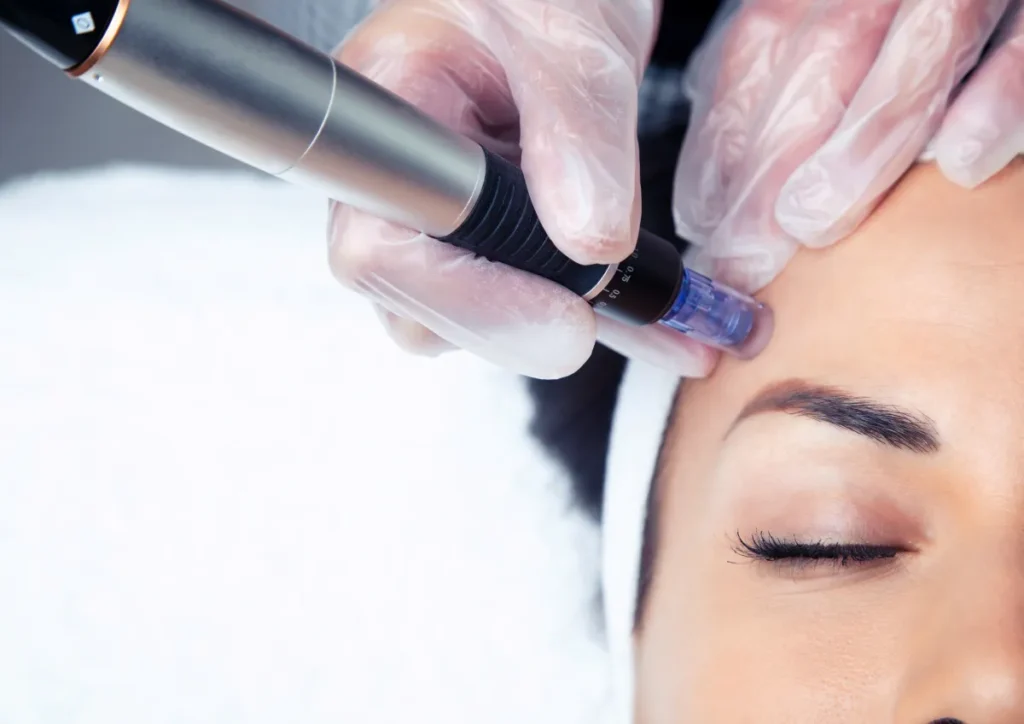
Dermapen microneedling uses fine needles to create controlled microchannels within the skin.
These micro-injuries initiate the skin’s natural repair response and stimulate collagen and elastin production.
Exosomes can then be applied as part of the treatment protocol.
At Swiss Aesthetics, this combination is called the Secret Duo Glass Skin.
The treatment brings together the collagen-induction effects of microneedling with an exosome-based formulation intended to further support the skin during the rejuvenation process.
If you want to understand the treatment itself in more detail, our guide to the benefits of microneedling explains how collagen induction can improve concerns such as texture, enlarged pores and acne scarring.
Morpheus8 + Exosomes
Morpheus8 takes a different approach.
Morpheus8 combines microneedling with radiofrequency energy. The needles penetrate the skin while controlled radiofrequency energy is delivered into deeper tissue.
This allows the treatment to target skin texture and collagen production while also addressing concerns such as mild laxity and skin firmness.
Exosomes can be applied following Morpheus8 as part of the treatment protocol.
Swiss Aesthetics calls this combination the Secret RF Duo.
Our complete Morpheus8 treatment guide explains the technology, results and recovery process in more detail.
Why Combine Exosomes With Microneedling?
This is one of the most interesting areas of current exosome research.
Microneedling already creates a controlled wound-healing response in the skin. The microchannels created during treatment also provide a route through which a topical product can interact more closely with the treated skin.
Researchers have therefore investigated whether combining microneedling with exosome-based preparations could improve outcomes compared with microneedling alone.
Dermapen + Exosomes vs Morpheus8 + Exosomes
Both Swiss Aesthetics treatments incorporate exosomes, but the underlying procedures are different.
| Secret Duo Glass Skin | Secret RF Duo | |
| Core treatment | Dermapen microneedling | Morpheus8 |
| Technology | Controlled microneedling | Radiofrequency microneedling |
| Exosomes included | Yes | Yes |
| Primary treatment focus | Skin quality, texture and rejuvenation | Skin quality, texture, collagen remodelling and tightening |
| May suit patients concerned about | Dullness, uneven texture, pores and general skin quality | Texture, fine lines, early laxity and skin firmness |
| Treatment information | Secret Duo Glass Skin | Secret RF Duo |
There isn’t necessarily one option that is “better”.
The more useful question is what are you trying to improve?
Someone primarily concerned with skin texture and radiance may require a different treatment plan from someone whose concerns include both skin quality and laxity.
A consultation allows the skin to be assessed before deciding which technology is the more appropriate foundation for treatment.
Are All Exosomes the Same?
No.
This is one of the most important things to understand when researching exosome treatments.
Exosome-based products can differ according to their source, method of production, purification, concentration, formulation and intended use.
That makes comparing two products simply because they both use the term “exosome” potentially misleading.
It is also one reason why researchers continue to call for greater standardisation within this area.
A 2026 review of commercially available topical exosome products found considerable variation between products and noted that information regarding their sourcing, processing and storage was often limited.
For patients, this means the quality and provenance of a professional product matter just as much as the word “exosome” appearing on its label.
What Does the Scientific Evidence Say About Exosomes for Skin?
The evidence is developing rapidly.
Recent clinical reviews have reported potential improvements in areas including skin hydration, elasticity, texture, wrinkles, pores and pigmentation.
At Swiss Aesthetics, we believe patients should understand both why a treatment is promising and where the evidence still has limitations.
What Should You Expect From an Exosome Treatment?
What happens during treatment depends largely on the procedure being combined with the exosomes.
For example, Dermapen and Morpheus8 use different technologies and therefore have different treatment experiences and recovery considerations.
Generally, the skin is assessed and prepared before microneedling or radiofrequency microneedling is performed. The exosome formulation is then incorporated into the treatment according to the relevant protocol.
Temporary redness, sensitivity or swelling can occur after microneedling-based procedures.
Your practitioner should explain:
- which treatment is being recommended and why
- what product is being used
- expected recovery and aftercare
- potential side effects
- how many treatments may be recommended
- realistic expectations for results
The exosome product should not replace appropriate consultation, treatment technique or aftercare.
Who Might Exosome Treatments Not Be Suitable For?
Exosome-based aesthetic treatments will not be appropriate for everybody.
Suitability also depends on the treatment being used to deliver or accompany the exosomes.
For example, treatments involving microneedling may need to be avoided or postponed where there is an active skin infection, compromised wound healing or certain medical conditions.
Pregnancy, breastfeeding, medication, previous treatments and underlying health conditions may also affect suitability.
A professional consultation allows both the treatment and the patient’s individual circumstances to be considered together.
Exosomes and the Future of Regenerative Aesthetics
Exosomes sit within a much broader shift in aesthetic medicine.
Rather than focusing exclusively on adding volume or temporarily changing muscle movement, there is growing interest in treatments designed to influence skin quality, collagen, tissue regeneration and cellular signalling.
That includes treatments such as microneedling, PRF, polynucleotides and other regenerative approaches.
Exosomes add another interesting area of research to this field because of the role extracellular vesicles naturally play in communication between cells.
The science is promising, but it is also evolving.
For patients, that makes informed treatment planning particularly important.
The question shouldn’t simply be:
“Should I have exosomes?”
A better question is:
“Which treatment approach is most appropriate for the changes I want to make to my skin, and would adding exosomes offer a useful role within that plan?”
At Swiss Aesthetics, exosomes can be incorporated alongside Dermapen through our Secret Duo Glass Skin treatment or alongside radiofrequency microneedling through our Secret RF Duo.
Book a consultation to discuss your skin concerns and determine which treatment approach may be most suitable for you.
FAQ’s
What are exosomes?
Exosomes are microscopic extracellular vesicles released by cells. They transport biological signals, including proteins, lipids and RNA, between cells and play a role in cell-to-cell communication. Their involvement in processes such as tissue repair and regeneration has created growing interest in their potential use within aesthetic skin treatments.
What does exosome therapy do?
The term exosome therapy or exosomal therapy can describe several different approaches, so there is no single universal treatment. Within aesthetics, exosome-based preparations may be used alongside procedures such as microneedling. Early research suggests potential benefits for skin hydration, texture, elasticity and rejuvenation, although larger and longer-term studies are still required.
What are the dangers of exosomes?
Research into topical exosome-based treatments has generally reported encouraging short-term safety findings, but the evidence base is still developing. Product quality, source, sterility, formulation and method of administration are important considerations. Treatments involving microneedling also carry their own potential side effects, such as temporary redness, sensitivity and swelling.
What is the best source of exosomes?
There is currently no single exosome source that can simply be described as “best” for every aesthetic application. Products can differ significantly in their origin, manufacturing, purification, concentration and supporting evidence. The quality and suitability of the specific formulation are therefore more useful considerations than choosing a product based solely on its source.
Can exosomes be combined with microneedling?
Yes. The combination of microneedling and topical exosome preparations is an active area of clinical research. Swiss Aesthetics combines exosomes with Dermapen as the Secret Duo Glass Skin treatment and with Morpheus8 radiofrequency microneedling as the Secret RF Duo.


